Industries & Applications

Industrial Gas Applications Across Sri Lankan Industries

Industrial gases are essential to welding, manufacturing, food processing, laboratories, construction, engineering and many other sectors. This page explains how common gases are used across different industries and what buyers should consider when selecting gas type, grade and supply method.

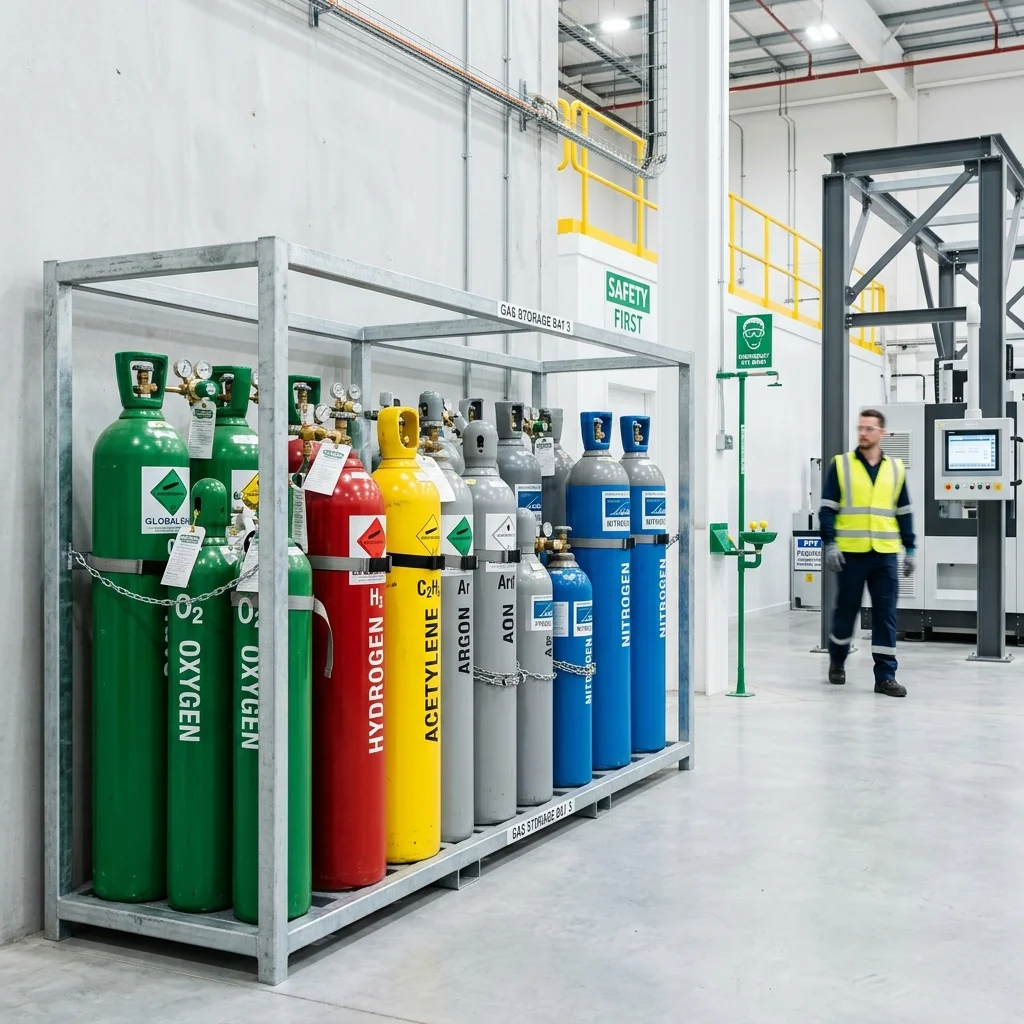
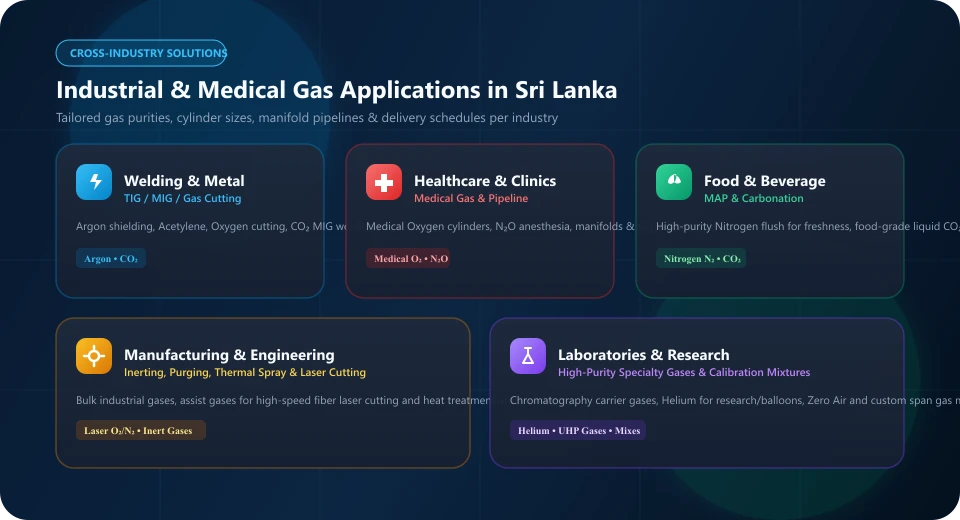
Illustration for Industrial Gas Applications Across Sri Lankan Industries on Gass.lk.
Illustration of industrial gas use across multiple industries including welding, manufacturing, food processing and laboratories.
Core Industries

Where Industrial Gases Are Commonly Used

Gas requirements vary significantly by sector. A welding workshop may prioritize shielding gas, oxygen and acetylene, while a food processor may focus on nitrogen or food-grade CO₂. Understanding the application helps identify the appropriate gas, purity, cylinder size and supply arrangement.

Healthcare, Hospitals & Clinics

Healthcare facilities use medical gases and medical gas infrastructure for clinical and technical functions. Medical oxygen is an essential medicine used in healthcare, while facilities may also require medical air, nitrous oxide and specialized gases or mixtures where clinically specified.

Typical topics: Medical oxygen, medical air, nitrous oxide, cylinders, manifolds, pipeline systems, terminal outlets, regulators, flowmeters and backup supply planning.

Important considerations: quality-assured gas, clinical governance, qualified system design, redundancy, safe storage, trained personnel and preventive maintenance.

Welding, Fabrication & Metalwork

Welding and fabrication are among the largest industrial-gas use cases. Argon is widely used for TIG welding and selected MIG applications, while CO₂ and gas mixtures are commonly used for MIG/MAG welding. Oxygen and acetylene are used together for cutting, heating, brazing and oxy-fuel work.

Typical gases: Argon, CO₂, Oxygen, Acetylene, Welding Gas Mixtures.

Important considerations: base material, welding method, penetration, shielding requirement, flow rate, cylinder consumption and regulator compatibility.

Manufacturing & Industrial Production

Manufacturers use industrial gases for cutting, heating, purging, inerting, controlled atmospheres, process support and maintenance. Oxygen may enhance combustion or cutting processes, while nitrogen is commonly used where an inert atmosphere is required. Argon may be used in specialized metal and fabrication processes.

Typical gases: Oxygen, Nitrogen, Argon, CO₂, Specialty Gases.

Important considerations: continuous consumption, purity, pressure, shift patterns, storage capacity, supply continuity and cylinder versus bulk requirements.

Food & Beverage Processing

Food and beverage businesses may use nitrogen and carbon dioxide for packaging, processing, inerting, carbonation or product preservation. Applications involving food contact require appropriate gas grade and process controls; industrial-grade gas should not automatically be assumed suitable.

Typical gases: Food-grade CO₂, Nitrogen, Liquid Nitrogen where applicable.

Important considerations: gas grade, food-contact suitability, purity, hygiene, packaging equipment, storage, consumption volume and traceability requirements.

Laboratories, Research & Technical Testing

Laboratories and research environments often require gases with clearly defined purity or composition. Nitrogen, argon, helium and specialty gas mixtures can be used in instruments, sample preparation, inert atmospheres, calibration and specialized analytical processes.

Typical gases: High-Purity Nitrogen, High-Purity Argon, Helium, Specialty Gases, Calibration Mixtures.

Important considerations: certified purity, mixture accuracy, regulator materials, contamination control, cylinder cleanliness and instrument specification.

Construction, Engineering & Site Work

Construction and engineering teams may use oxygen and acetylene for cutting, heating and repair work, along with welding gases for structural fabrication and maintenance. Portable cylinder supply and safe transport are often important on project sites.

Typical gases: Oxygen, Acetylene, Argon, CO₂, Welding Gas Mixtures.

Important considerations: site safety, cylinder securing, ventilation, transport, regulator protection and quantity planning.

Automotive, Repair & Maintenance Workshops

Automotive and general repair workshops may require shielding gas for welding, oxygen and acetylene for cutting or heating, and other gases for maintenance tasks. Consumption is often cylinder-based and may vary depending on workload.

Typical gases: Argon, CO₂, Oxygen, Acetylene, Welding Mixtures.

Important considerations: cylinder size, refill frequency, regulator compatibility, workshop ventilation and storage practices.

Metal Processing & Heat Treatment

Metal processing can require gases for cutting, shielding, atmosphere control and heat-treatment support. Nitrogen and argon are particularly relevant where oxidation must be reduced, while oxygen is important in cutting and combustion-enhanced processes.

Typical gases: Nitrogen, Argon, Oxygen, Specialty Gas Mixtures.

Important considerations: process temperature, atmosphere requirement, gas flow, purity, production volume and continuous supply reliability.

Electronics, Precision Manufacturing & Controlled Atmospheres

Advanced manufacturing and electronics-related processes may require high-purity nitrogen, argon or specialty gases to create inert atmospheres, reduce contamination or support technical production processes.

Typical gases: High-Purity Nitrogen, High-Purity Argon, Specialty Gases.

Important considerations: purity certification, moisture/oxygen limits, pressure control, filtration and contamination prevention.

Application-Based Selection

Match the Gas to the Process

Shielding

Argon, CO₂ and selected mixtures help protect the weld pool from atmospheric contamination. Selection depends on welding process, material and desired weld characteristics.

Cutting & Heating

Oxygen and acetylene are widely associated with oxy-fuel cutting, brazing and heating. Correct regulators, flashback protection and safe handling are essential.

Purging & Inerting

Nitrogen and argon are commonly used where oxygen or reactive gases need to be displaced from tanks, pipelines, vessels or production environments.

Cooling & Freezing

Liquid nitrogen and other cryogenic solutions may be used for controlled cooling or freezing. Cryogenic gases require specialized equipment and handling procedures.

Food Packaging & Carbonation

Nitrogen and CO₂ can support modified-atmosphere packaging and beverage applications. Gas grade and suitability must match the food or beverage process.

Laboratory & Calibration

High-purity and specialty gases may be used for instrument operation, calibration, analytical testing and controlled research environments.

For Business Buyers

Plan Supply Around Your Usage Pattern

Industrial gas purchasing should consider more than the immediate cylinder requirement. Businesses with frequent or high-volume consumption should evaluate delivery frequency, backup stock, storage capacity, cylinder turnover and future growth.

  • Average weekly or monthly gas consumption
  • Number of active workstations or machines
  • Required cylinder size or supply format
  • Expected refill/exchange frequency
  • Site storage and safety arrangements
  • Delivery access and location
  • Need for backup cylinders
  • Purity or certification requirements
Frequently Asked Questions

Industry & Application Questions

Which gas is commonly used for TIG welding?

Argon is commonly used as a shielding gas for TIG welding. The exact gas or mixture depends on the material, process and welding procedure.

Which gases are used in food processing?

Nitrogen and carbon dioxide are commonly used in selected food and beverage applications. The gas grade and suitability should be confirmed for the specific process.

What gas is used for industrial purging?

Nitrogen is commonly used for purging and inerting because it is non-reactive in many industrial processes. Argon may also be used where process requirements call for it.

How can a factory decide between cylinders and a larger supply system?

The decision depends mainly on consumption volume, peak demand, storage space, delivery frequency, process criticality and economics. High-volume users may benefit from a larger supply arrangement.

Can one industrial gas be used for multiple industries?

Yes. Oxygen, nitrogen, argon and CO₂ have many applications, but purity, grade, equipment and safety requirements may differ between industries.

Find the Right Gas for Your Industry

Discuss Your Application with Gass.lk

Share your industry, process, required gas, expected quantity and delivery location so your enquiry can be matched to the right industrial gas category.